Solutions
Mercury
The conops you wrote, running.
Live mission assurance in daily operations: what to watch, what matters, what to do, applied on every pass.
Ask for a demomercury.intella.tech/events
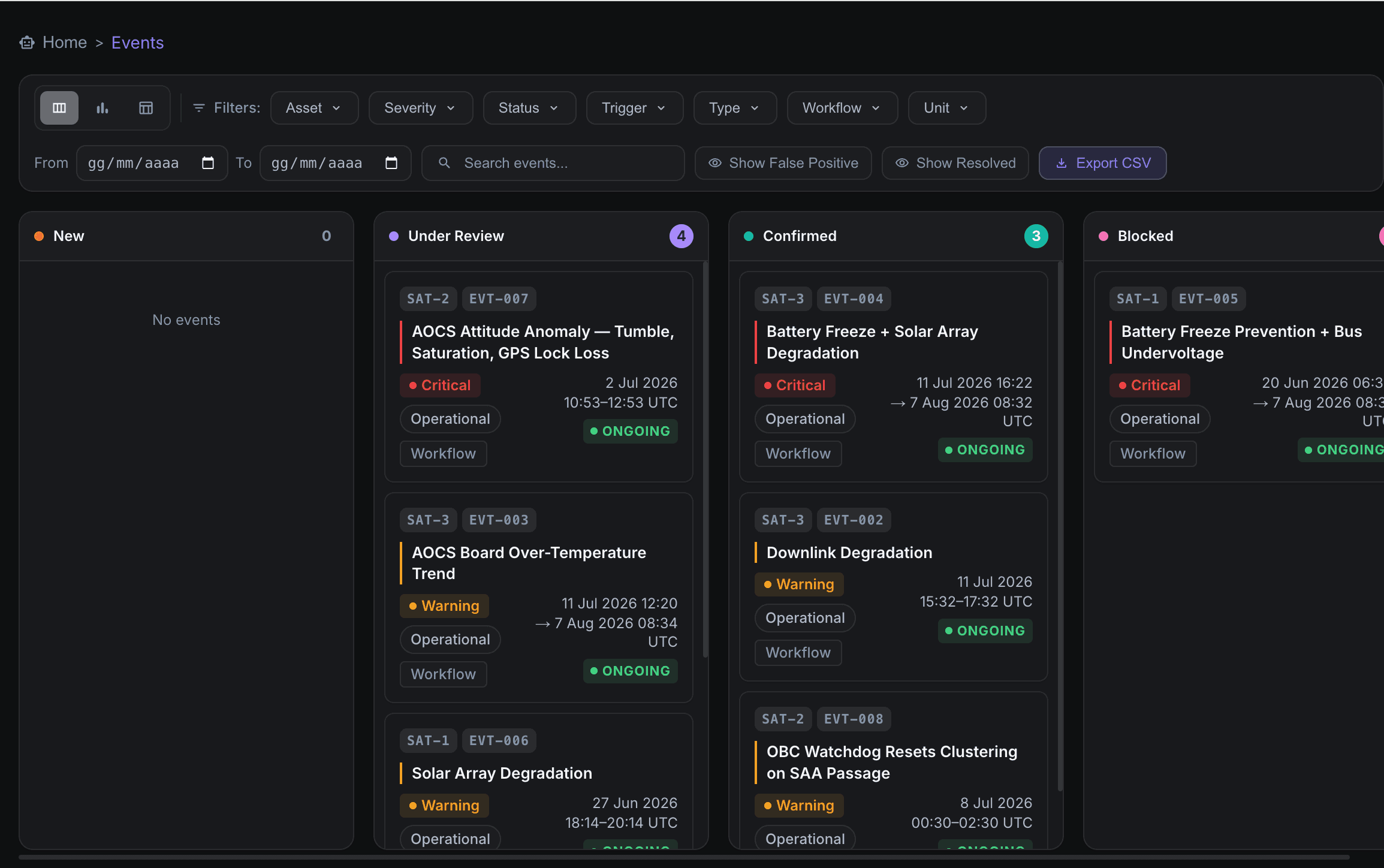
Detection tells you something changed. Mercury tells you whether the fleet is still operating as intended, and what to do when it is not. Telemetry and signals become qualified events with a recommended action, so a lean team can run a growing fleet.
This is your operational case, kept live: the procedures, limits and escalation paths you wrote before launch, running on every pass instead of sitting in a document.
It runs alongside your mission control system. No re-architecture, no replacement of existing tools, no disruption to live operations.
How Mercury works
01
Ingest
Telemetry from your MCS, your satellite data model, and mission context such as operational modes, space weather and orbital data.
02
Correlate
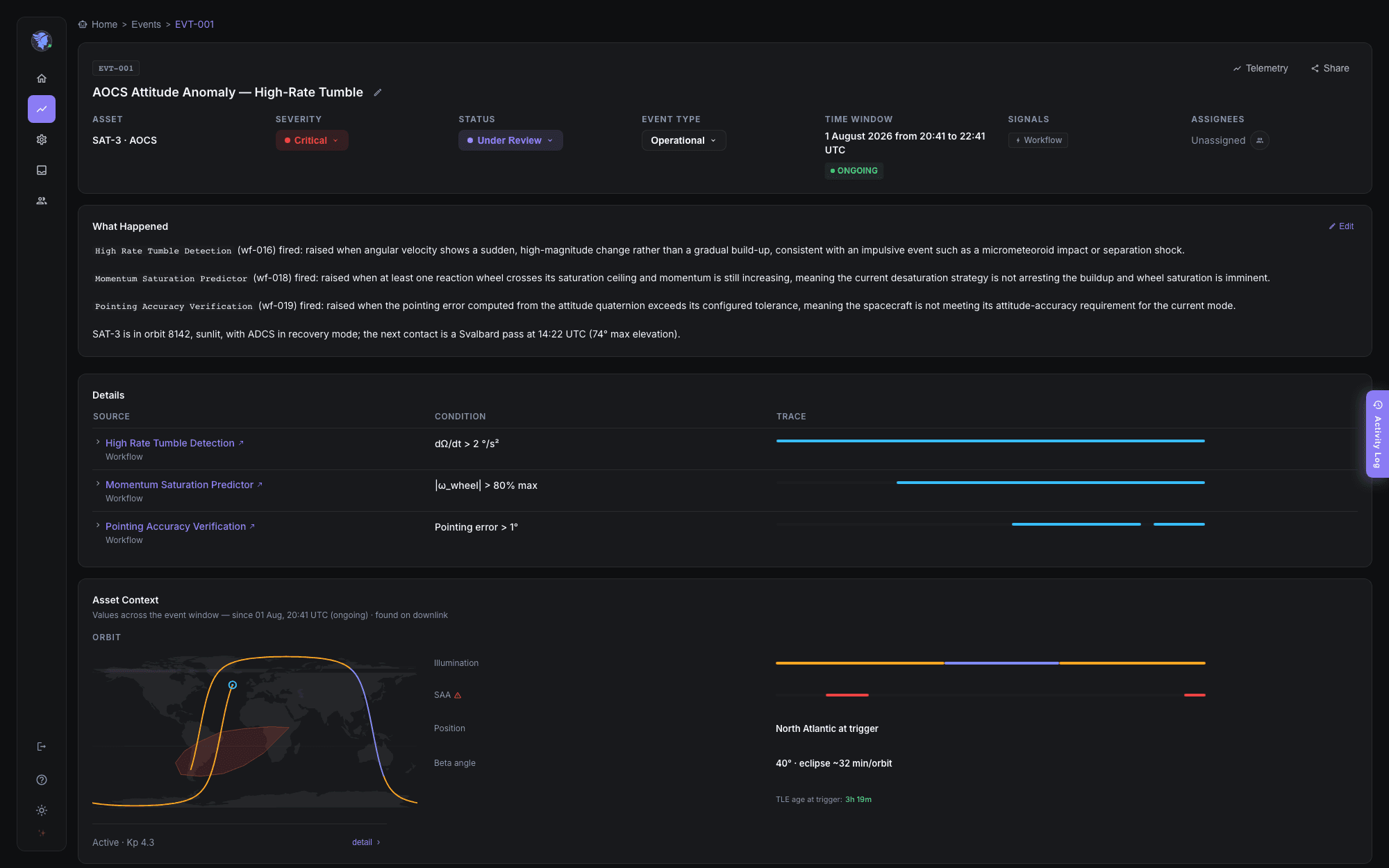
Three kinds of signal come in. Physics-based degradation modeling in Hydra reports what is wearing out. Advanced deterministic logic encodes what you already know. AI detection flags what no rule anticipated. Mercury groups the signals that belong to the same spacecraft into one thread, adds the context they happened under, and surfaces past events that look like this one along with what was done about them.
03
Generate
One qualified event instead of many alerts: what happened, why it matters, and the procedure to apply. Events follow your procedures. Mercury recommends and hands off. Your team decides.
04
Retain
Every event and every action becomes a durable record. Recurring signatures are triaged faster, handovers stop depending on who is on shift, and your assurance evidence accumulates as a by-product of doing the work, rather than being reconstructed for a review.
Before and after
| Before Mercury | With Mercury |
|---|---|
| Operators manually confirm nominal behavior every shift | Routine checks run continuously in the background |
| Alert floods and false positives demand constant attention | Fewer, higher-confidence events reach operators |
| Investigations mean dashboard hopping and manual correlation | Each event arrives with context and a recommended action |
| Procedures live in documents, and in the heads of a few senior people | Your conops is documented and implemented at the same time: the workflow is the procedure |
| A lesson learned on shift rarely makes it back into how the work is done | Anyone on the team can improve a workflow, no code required, under approval and with a full audit trail |
What you get
Operations
- Less time in triage. Events arrive qualified, ranked and owned.
- Less time to resolve. Diagnosis, history and next steps on one page.
- Less alert noise. False positives tracked and tuned out.
- Less handover time. The shift summary writes itself.
Business
- More fleet capacity per operator. Operations scale as the fleet grows.
- More knowledge retention. Procedures live as versioned workflows, not in heads.
- Less reporting and audit effort. Generated automatically, traceable by design.
- Less operator onboarding time. Context and procedures are in the platform from day one.
How Mercury fits your stack
Mercury integrates with your mission control system and runs in your cloud or on-prem environment. Telemetry in by pull or push, events out through your existing channels and a full API. SSO through your identity provider.
Two ways to use it. In the background, the engine produces events and notifications into the tools you already have. In the interface, operators investigate with full telemetry context in one place.
Most teams already have detection and alerting. The question is what happens in the twenty minutes after an alert fires. If an engineer is still opening three tools and a telemetry archive to work out whether it matters, that is the part Mercury covers. It sits on top of what you already run rather than replacing it.