Solutions
Hydra
Live mission assurance across the whole mission.
Monitoring tells you the battery is fine today. Hydra tells you how much of it is left.
Ask for a demomercury.intella.tech/reliability
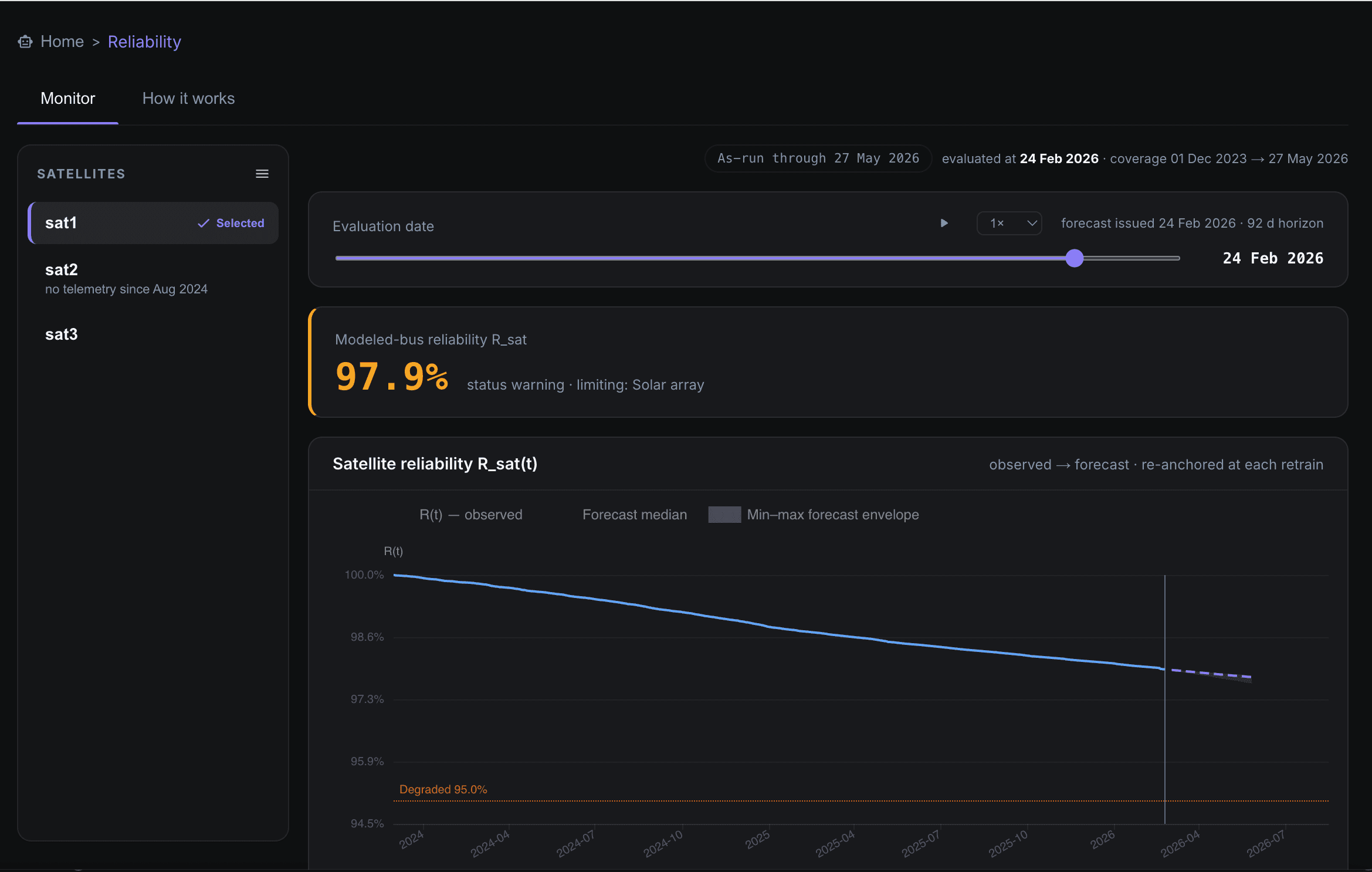
Hydra is the reliability engine for your fleet. It reads the stress each component has actually absorbed in flight, recomputes reliability continuously, and forecasts when it will cross the line.
This is mission assurance carried through the whole mission, not closed out at design review: the reliability case you built before launch, kept live with flight evidence.
It runs on the housekeeping telemetry you already downlink. No new sensors, no observed failure databases, no large historical fleet required.
How Hydra works
Telemetry-driven reliability updating and prognostic disposal readiness are recognized in RAMS practice. What is rare is maintaining them continuously in flight, on the operator’s own design baseline.
01
Ingest
The housekeeping telemetry you already downlink, your design baseline from CDR including reference failure rates and the redundancy scheme, and operating context such as operational modes, duty cycles and eclipse cadence.
02
Model
Telemetry becomes the stress each component actually experienced. Hydra adjusts its design-phase failure rate according to known failure physics and rolls the result up through your redundancy scheme.
03
Reliability
Live reliability per component and for the whole bus, reassessed on a regular cadence, with clear tier crossings from nominal through warning and degraded to critical. The tiers are ours, aligned to ECSS practice.
04
Forecast
Reliability projected across the remaining mission, with an estimate of when it crosses the acceptable floor against your planned end of life. The forecast is retrained as telemetry accumulates and whenever behavior changes, so the answer stays current instead of aging with the model.
The model is deliberately transparent. It collapses to your qualified design baseline when the vehicle is flown as designed, and diverges only as measured stress departs from it. Every change traces back to an observable cause.
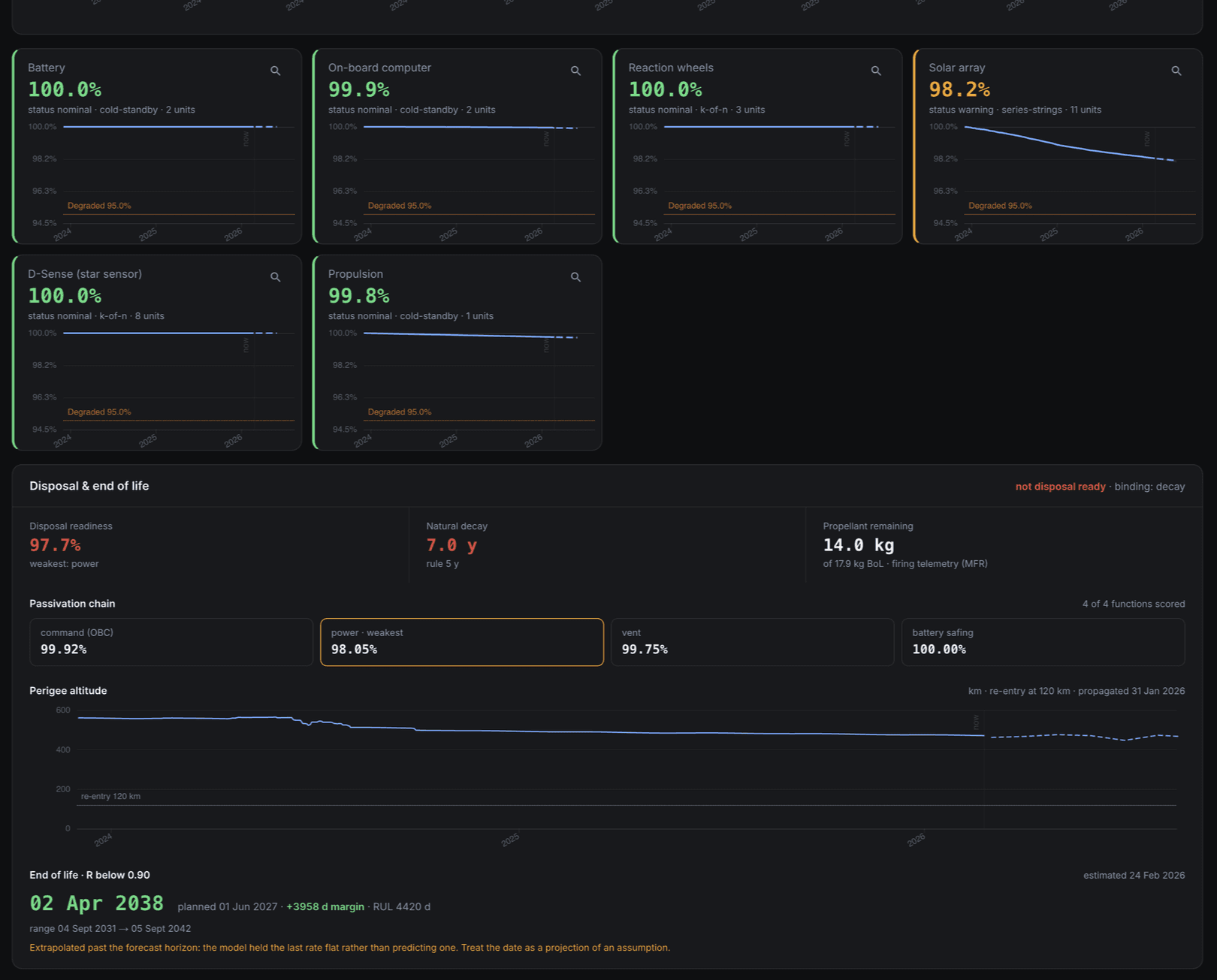
Subsystems do not age in isolation either. When a solar array drifts, the battery cycles deeper to hold bus voltage, and that ages the battery faster. Hydra follows the coupling, so aging upstream becomes a decision downstream.
Hydra produces the evidence. Your team makes the call.
Before and after
| Before Hydra | With Hydra |
|---|---|
| End-of-life calls rest on numbers fixed at design review, years before decommissioning | Reliability reflects how each satellite has actually been flown |
| Extend or retire is a judgment call, argued rather than evidenced | Extend or retire is decided on flight evidence, and the number can be defended |
| Degradation building for years reads nominal on a limit check | Slow degradation surfaces while there is still time to act on it |
| Reliability is reassessed periodically, or only after something fails | Reliability is recomputed continuously, not reconstructed for a review |
| Disposal readiness is declared, not demonstrated | Disposal readiness is tracked against the requirement and auditable at any point |
| Doing this properly needs a ground RAMS team most operators do not have | A small team gets a continuous reliability picture without building the models |
What you get
Operations
- Visibility of slow degradation. Wear that reads nominal on a limit check becomes visible.
- Less time to assess an asset. Reliability is current, not rebuilt for each review.
- Confidence in the extend-or-retire call. Backed by flight evidence, traceable to cause.
- Fewer surprises at end of life. Erosion shows up while options are still open.
Business
- More usable life per asset. Extend where the life is genuinely there.
- Defensible useful-life assumptions. Useful life is an assumption carried on your balance sheet. Flight evidence is what lets you revise it, and defend the revision.
- Lower risk of losing disposal capability. Act before reliability crosses the floor, not after.
- Lower compliance exposure. Disposal readiness evidenced against ISO 24113 and the FCC five-year rule. The tool produces the evidence, the operator makes the call.
- Better fleet planning accuracy. Replenishment on the real window, not the datasheet one.
How Hydra fits your stack
Hydra runs on telemetry from your existing mission control system, in your cloud or on-prem environment. Nothing changes on the spacecraft and nothing changes in how you fly it.
Every model parameter is exposed and editable, and every default traces to a recognized standard or to in-orbit calibration. No hidden constants. Configuration is per mission and re-targetable across orbit regimes, from LEO to GEO.
Two ways to use it. On its own, as your continuous reliability and disposal-readiness picture. Or feeding Mercury, where a degradation signal becomes a qualified operational event with a recommended action.
Run it on one of your missions. Share telemetry from a mission where you already know the outcome. We run the models, and you judge the output against your own ground truth.