 New · Mercury v2 · Live at Space Tech Expo Bremen, 17 to 19 Nov
Your best engineer’s judgement, on every satellite, all the time.
Mercury v2 automates the checks and analysis on your mission data. Build advanced workflows across all your data sources. They read the full mission context and documentation. Related anomalies become one event, not a flood of alerts.Very easy to design. Less noise. Pure focus.
Book a demo in Bremen (opens in a new tab)app.intella.tech/events
Trusted by



Satellite operator, undisclosed
01The problem
One operator, twenty satellites: a recipe for disaster. Not with Mercury.
Today, an operator opens a dashboard, gets a partial picture of fleet health, and moves on to tasking and payload operations. The picture stays the same size while the fleet grows. Investigations take longer, handovers get less reliable, and the team quietly comes to depend on the few people who carry the context in their heads.
More alerts don’t fix that. They add signals without making a single decision easier.
02Inside Mercury v2
From telemetry to decisions.
One workflow, one event, one shift. Follow a single case from the logic your team writes to the decision it lands on.
01Write it onceYour procedure, as logic.
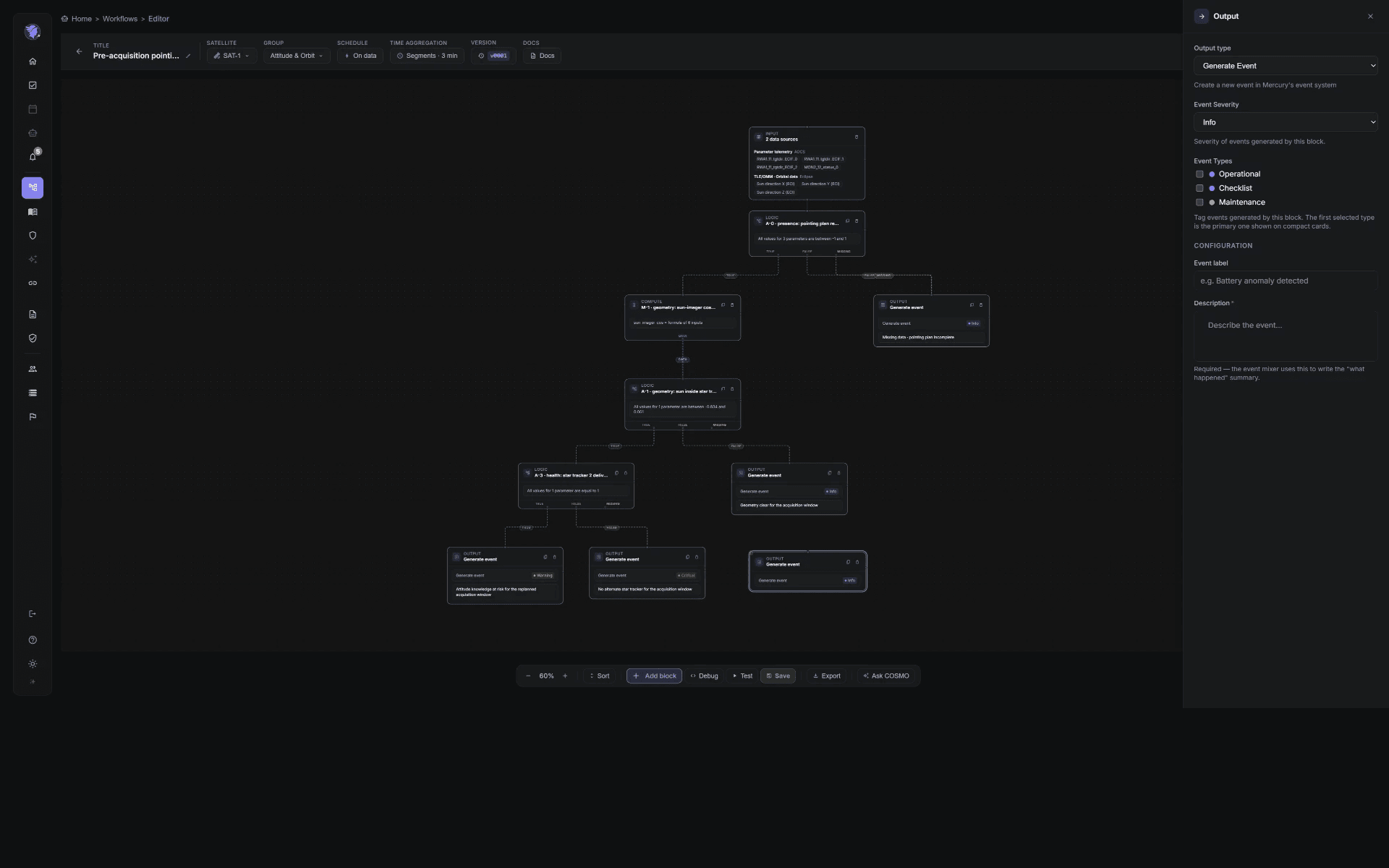
The checks your ops team would make, built as blocks: telemetry and orbital data in, conditions, the event out. Versioned, testable and yours to edit. No code.
- Input
- Telemetry + TLE/orbital data + space weather
- Logic
- True, false and missing data, all handled
- v0001
- Every change versioned
app.intella.tech/workflows/editor
02Start the shiftOperational events. Ranked. Ready.
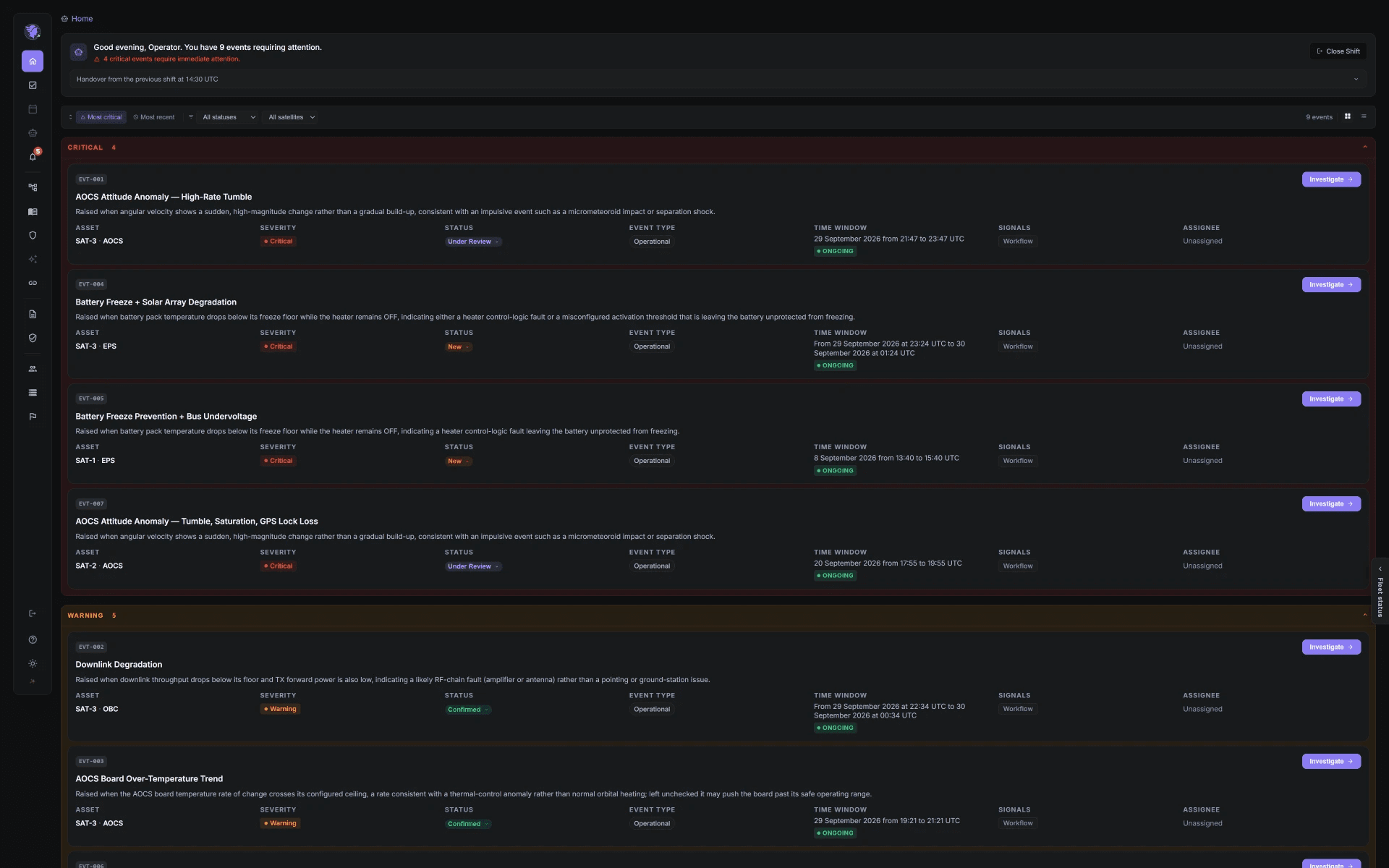
The shift opens with the handover and every event that needs attention, sorted by severity. Each one already says what was raised and why. Nobody has to go looking.
- Handover
- From the previous shift, built in
- Critical / Warning
- What matters first
- SAT-1 · SAT-2 · SAT-3
- The whole fleet, one list
app.intella.tech/events
03Make the callA decision to make, not an investigation to run.
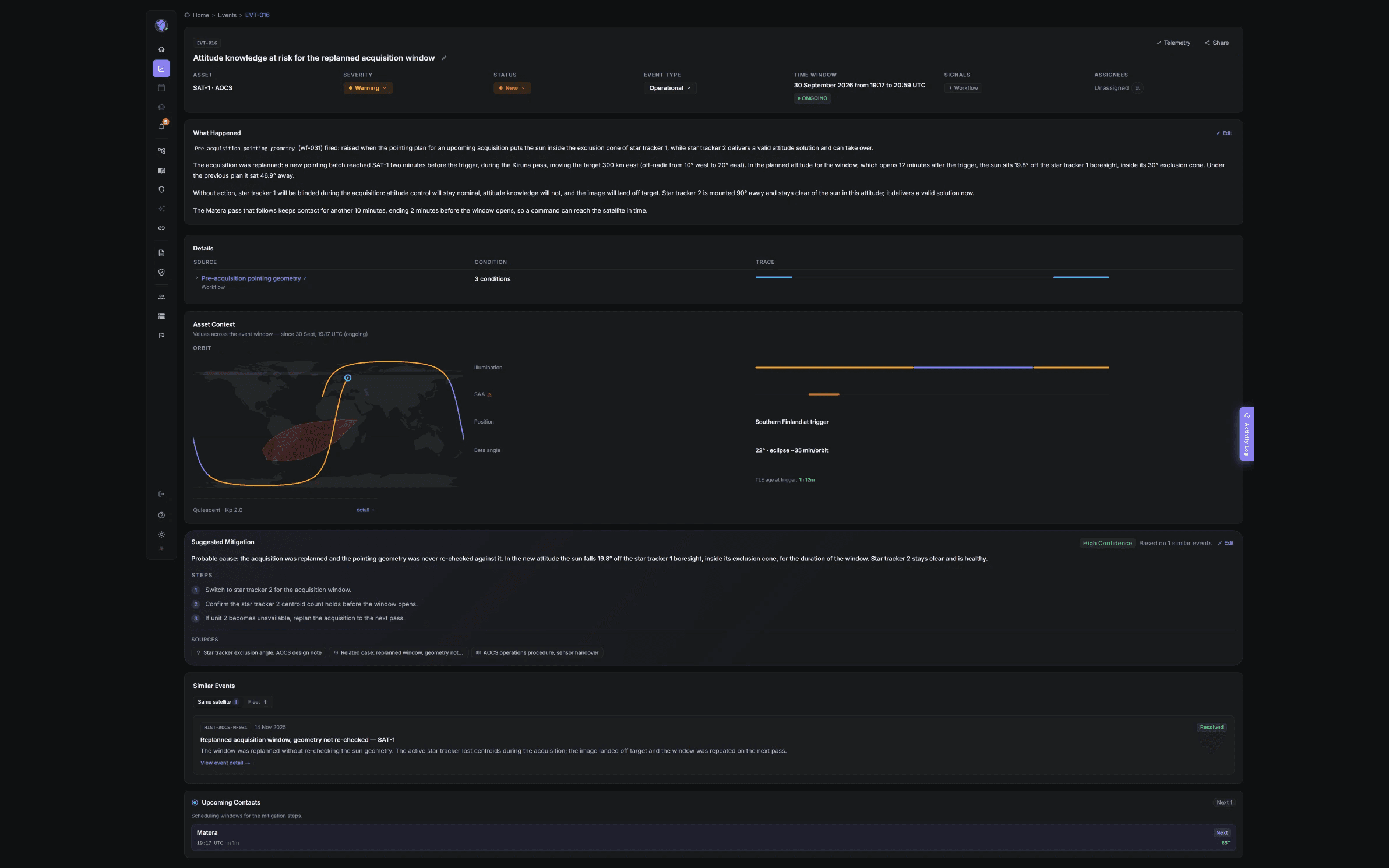
What happened, in plain language. The orbit and context at the trigger. A suggested mitigation with steps, its confidence and its sources. The last time this happened on the fleet. And the next ground contact, so you can act in time. Mercury proposes. Your team decides.
- What happened
- Written from the workflow, not a raw threshold
- Suggested mitigation
- Steps, confidence, sources
- Similar events
- What happened last time
- Upcoming contacts
- When you can act
app.intella.tech/events/EVT-016
app.intella.tech/workflows/editor
app.intella.tech/events
app.intella.tech/events/EVT-016
03Built to fit your operations
Nothing to replace. Nothing to move.
Mercury v2 sits on top of the stack you already trust. Your telemetry, your infrastructure, your procedures.
Integration
Runs alongside your MCS.
Spacecraft
Nothing changes on board.
Deployment
Inside your perimeter.
Audit
Every change on record.
04Two questions worth asking
- Can your team absorb the next ten satellites?
- How long does it take your team to decide what a signal actually means?
If either answer is uncomfortable, let’s talk in Bremen, 17 to 19 November.